


Chairperson's Messages
Toward the Realization of a "Collaborative Growth Society"
ー Transforming Cutting-Edge Technology into the Strength to Live ー
[Chairperson's Remarks at the Fiscal 2026 April Annual Meeting]
April 21, 2026
Akio Yamaguchi
Chairperson
Keizai Doyukai (Japan Association of Corporate Executives)
- What Kind of Society Should We Aim to Achieve?
Four months have already passed since I was appointed as chairperson this January, and I have spent that time constantly busy and keenly aware of the weight of this responsibility. At today's annual meeting, I would like to convey, once again, the direction I am pursuing.
I will start by frankly asking a question. Are we satisfied with how things are in Japan today? What kind of society should we aim to achieve?
Keizai Doyukai (Japan Association of Corporate Executives) was established on April 30, 1946, just after the war ended. The establishment statement of intent declares, "We want to devote all our strength as businesspeople to construct a new Japan. The role played by the economy in the reconstruction of Japan is extremely important. That is because the economy is certainly the cornerstone of reconstruction."
Today, 80 years later, nothing has changed in our mission to contribute to Japanese society as businesspeople. As we carry on the legacy that has been built up by prior chairpersons, I would like to answer this question in my own words.
For many years, I worked on the frontlines of technology. As the manager of a company that provides AI and as someone actually involved in using AI to transform operations, I have closely watched what this technology brings to our society. There are things I am sure of from that experience. Depending on how it is used, technology can enrich people's lives or make them unhappy. What is being questioned is not the technology itself but rather how it will take root in society and for whom it will be used. In other words, what is being questioned is our very will.
Looking at the world, the sudden evolution of AI and other technologies is changing industrial structures and workstyles from their very roots. At the same time, as evidenced by of the ongoing US-China confrontation, the war between Ukraine and Russia, the military campaign by the US and Israel against Iran, and the closing of the Strait of Hormuz, the international order is being profoundly shaken. The increase in the price of crude oil from the heightened tensions in the Middle East has had an impact on the Japanese economy and the world as a whole, and the importance of economic security is rising more than ever before.
However, we must not lose sight of the basic understanding that the people of every country desire peace and prosperity. Precisely because this is an era when divisions emerge from differences in interests and values, the will to contribute to rebuilding order based on dialogue and cooperation is important. On the domestic front, Japan faces many challenges such as population decline, labor shortages, price increases, real wages, and regional revitalization. At the same time, however, there are certainly signs of change. At companies, a movement toward business restructuring is emerging. Also, startups and NPOs are being formed in every part of the country, and they are responsible for creating new businesses and resolving issues. Even in the technology era, diligence, sincerity, teamwork, and social stability and reliability, as well as Japanese products and technology backed by the tradition of craftsmanship and manufacturing, are still a major strength for Japan. - Moving Japan with Collaboration and Growth
What kind of society should we aim to achieve? My answer is clear.
It is a "collaborative growth society"--a society that transforms cutting-edge technology into the strength to live.
Why are we calling for "collaboration" and "growth" together at this time?
The Japan we seek to realize is an economy and society that maintains a high level of autonomy even amid drastic changes in the international situation; one where citizens help and care for one another; one where everyone has a place to be and a stage to perform on and consequently feels happiness; and one that has the strength to attract global talent and capital.
In achieving this, economic growth is an essential necessary condition. However, growth, by itself, cannot be called a sufficient condition. To build up a world where we join hands and everyone can enjoy happiness, the spirit of collaboration--where we grasp other people's hardships as our own and proceed toward solutions together--is the key.
As socioeconomic issues become more complex and we approach the limits to solutions from public assistance alone, activities where NPOs, impact startups, and companies collaborate across boundaries and combine their respective knowledge and resources have great significance. The ultimate form of the collaborative growth society we seek is one where both strong, sustained economic growth and the spirit of collaboration with consideration for others continuously evolve toward the future. - Toward Doubling Nominal Per Capita GDP in 2040
The realization of the collaborative growth society requires specific targets. Society is not moved by slogans alone.
As a goal, we aim to raise the nominal per capita GDP to twice the current level by the early 2040s. This means maintaining a nominal GDP growth rate of 3% per year and a real growth rate of at least 1% per year over an extended period of time. This is by no means just a pipe dream. It is a target that will be well within our reach if we share the goal to be realized, work sincerely to achieve it while strictly managing the progress, and have the will to do what must be done.
I am convinced that this will come to fruition amid a virtuous cycle: corporate reform is the starting point, those changes lead to increased investment, market creation, and social progress, and that again prompts the next reform. - The "Seven Bridges" to Achieving a Collaborative Growth Society
It goes without saying that there are great gaps between the image of society in 2040 and the Japan of today. To close these gaps, we need to address essential issues and change the status quo. This is the aim of the "seven bridges" through FY2035.
First, as short-term measures that will produce results by FY2027, we will immediately engage in activities for the two bridges of "livelihood protection and safety net construction" and "corporate metabolism and revitalization" to regain the enthusiasm of the economy. In addition to maintaining the momentum of wage increases, we corporate executives will boldly advance structural transformations, including the divestiture and
restructuring of unprofitable businesses. Meanwhile, we will urge the government to reconstruct safety nets, including refundable tax credits, and reform labor legislation to support smooth labor mobility.
Next, in the aim to reinforce supply capacity--a target we want to achieve by FY2030--we will advance activities for the bridges of "establishment of a foundation for safety and security" and "evolution of industrial structure and creation of new industries." We will accelerate the industrialization of medicine and nursing care, the expansion of physical AI and robot investment, and the social implementation of quantum, space, and other cutting-edge technologies, working to propel the transition to a highly efficient industrial structure and creation of new markets. We will recommend that the government eliminate bedrock regulations that hinder innovation in medicine, agriculture, and other fields and make strategic investments toward reinforcing the foundations of the energy and defense industries.
We also look to take long-term measures to drive the completion of a high value-added nation in FY2035. Specifically, we will advance activities for the bridges of "realization of affluence and happiness" and "business expansion in the global market." While we continue to pursue social inclusion where a diverse mix of individuals can shine (diversity, equity, and inclusion: DEI), we will promote the strategic diversification of supply chains and export markets and the reinforcement of the power to earn money in the global arena. We will ask the government to innovate education, thereby fostering the next generation of human resources, and create an environment to attract investment from around the world.
The foundation that will support these activities is the bridge of "further development of Keizai Doyukai." What I am aiming at is our evolution into a next-generation type economic organization where all members can fully utilize AI as a practical tool in their daily lives and in management. While taking the lead in highest priority issues and crosscommittee themes, the Planning and Coordination Committee will immediately launch the activities of each individual committee. At the same time, we will prepare a framework to articulate Keizai Doyukai's positions and the status of our proposals in
action, upgrade the secretariat function accordingly, and thus simultaneously enhance our proposal and execution abilities. In addition, we will create opportunities and venues to foster next-generation corporate executives and promote mutual study and exchange among members, thereby further boosting member engagement.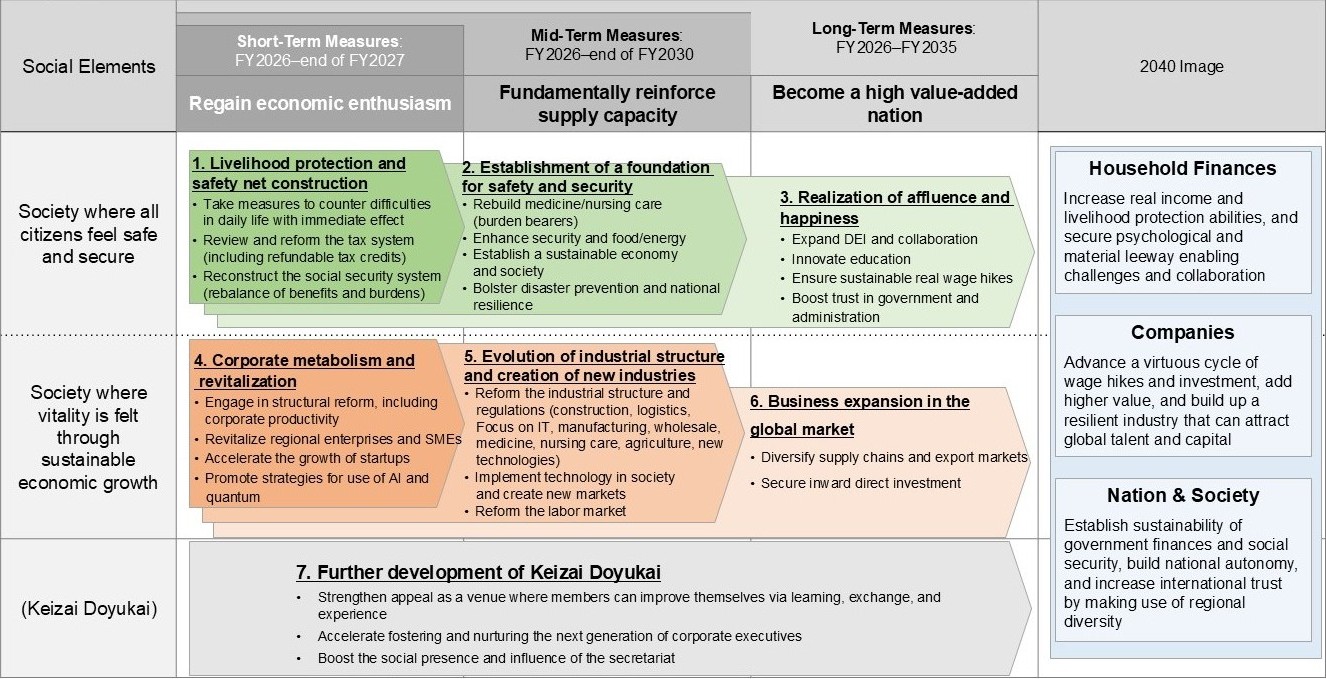
- Execution, Open, Growth--the Three Commitments
In closing, I would like to voice my own commitments.
Execution: Implement and Focus on Results
The proposals of Keizai Doyukai only have meaning when they move society. Making proposals is just the beginning. We must persistently lobby government, political parties, and concerned organs, manage progress, and maintain activities until results are achieved. We must earnestly work toward the goals that should be reached. That is what I want to give the most importance.
Now, there are two things that we need to address from today onward.
The first is the launch of the Keizai Doyukai Institute. Rooted in unique content and proposals based on first-hand information from corporate executives, this institute will develop dialogues with government, political parties, media, academia, NPOs and other bodies and exert an influence on the formation of policy and public opinion. We will feed back the responses and knowledge gained from this to committee activities and members and refine the content on an ongoing basis. We will also strengthen ties and collaboration with Keizai Doyukai corporate executives nationwide, academia, think tanks, and other bodies.
The second is the establishment of a fund. Together with the Japan Association of New Public and the Impact Startup Association, Keizai Doyukai has been exploring the establishment of frameworks for providing funds between companies and the social sector, and today, I am announcing our proposal. We will immediately begin the establishment of a fund, which is one of these frameworks, for the funding of NPOs engaged in largescale
disaster relief and support of children and youth.
Open: Open and Connect
Keizai Doyukai is a collection of prominent individuals. Its value is best manifested through open dialogue both internally and externally. We will further promote open communications and knowledge sharing among members, of course, and with government, academia, NPOs, media, and other diverse stakeholders. We will also deepen relations with the 44 regional Keizai Doyukai associations throughout Japan, gain greater mutual understanding of the important policy issues facing regions, and promote interregional cooperation.
In our organizational operations, members and the secretariat will work as a team in advancing cross-sectoral collaboration that transcends committee boundaries and pursuing other efforts. Creating a place where the prominence of each member causes a chemical reaction--that is the path to maximizing the strength of Keizai Doyukai.
Growth: Individuals, Organizations, and Society All Grow
The goal of the collaborative growth society is not economic growth alone. Our members should grow as corporate executives and change the organizations they manage--a process that will also enable society as a whole to grow. Promoting this threelayered growth is the role of Keizai Doyukai.
This year, Keizai Doyukai will celebrate the 80th anniversary of its founding. We will hold a commemoration ceremony on November 27, convey our gratitude to all our stakeholders who have supported us over our 80-year history, and present anew the image of the economy and society that Keizai Doyukai aims to achieve and our role as an essential business organization for society. I would like to make this milestone a starting point for Keizai Doyukai to make new history and achieve further growth together with our members.
Now, I have a request for all of you. I want each one of you to please continue functioning as an agent of change. We cannot just wait for someone to solve, for us, the issues which I spoke about today. It is our actions that will change society.
Japan is now in a phase of great transformation. We need to spark innovation through investment that is proactive, not defensive, and pioneer the next growth frontier. I want Keizai Doyukai to be a gathering of corporate executives who spearhead this movement.
With the three commitments of Execution, Open, and Growth, working as a united team with Keizai Doyukai members, I will devote my utmost efforts to achieve a collaborative growth society.
Thank you very much.
記事をシェアする


